
Metal siding has moved well beyond its agricultural and commercial origins. Today’s residential metal siding options offer a range of profiles, finishes, and panel systems that deliver exceptional durability and low maintenance in a contemporary or industrial-aesthetic package that’s become increasingly popular in Greater Seattle’s design-forward architectural landscape. For homeowners prioritizing longevity, fire resistance, and true low-maintenance performance in the Pacific Northwest’s demanding wet climate, metal siding is a compelling choice.
Integrity Roofing & Construction installs metal siding systems throughout Greater Seattle, bringing the same roofing and moisture management expertise we apply to every exterior project to the specific requirements of metal siding installation. We hold Washington State General Contractor Registration #INTEGRC841J1 and back every installation with our 20-year workmanship warranty.
Schedule your free metal siding estimate with Integrity Roofing & Construction today.
Types of Metal Siding We Install
Steel Siding
Steel siding is the most common and most durable metal siding option for residential applications. Modern steel siding panels are coated with a zinc-aluminum alloy layer (Galvalume) and a baked-on paint system that provides excellent resistance to corrosion in Greater Seattle’s damp, coastal-influenced climate. Steel siding is available in traditional lap profiles, board and batten, and vertical panel configurations.
Aluminum Siding
Aluminum siding is lighter than steel and naturally corrosion-resistant — an advantage in Greater Seattle’s marine environment. It’s more prone to denting than steel but won’t rust if the surface coating is damaged. Aluminum siding has been a residential staple for decades and remains a practical option for homeowners prioritizing low maintenance and corrosion resistance.
Standing Seam Metal Panels
Standing seam metal panels — the same system commonly used in metal roofing — are increasingly used as residential siding on contemporary Pacific Northwest homes. The concealed fastener system and continuous vertical panel run create a clean, architectural appearance with minimal maintenance requirements and excellent weathertightness.
Corrugated Metal Panels
Corrugated metal panels offer a more textured, industrial aesthetic and are used in both residential and commercial applications. They’re available in steel, aluminum, and Corten weathering steel, and their profile provides additional rigidity relative to flat panels of the same thickness.
Why Metal Siding Performs Well in Greater Seattle
- Non-porous — metal does not absorb moisture, eliminating the rot and moisture-related decay that affects wood-based siding in the Pacific Northwest
- Moss and algae resistance — the smooth, non-porous surface of metal siding does not support biological growth in the way that wood, stucco, or textured composite surfaces can
- Fire resistance — steel and aluminum siding carry non-combustible ratings, a meaningful advantage in Greater Seattle communities near forested areas
- Wind resistance — properly fastened metal siding panels perform well in the high-wind events common along the Puget Sound corridor
- Longevity — quality metal siding systems with factory-applied finishes have lifespans of 40 to 60 years, far exceeding most wood or composite alternatives
Metal Siding Installation Details That Matter in Greater Seattle
Thermal Expansion and Contraction
Metal expands and contracts with temperature changes. In Greater Seattle’s climate, seasonal temperature swings are moderate but significant enough that proper allowances must be made during installation. Siding panels that are fastened too rigidly will buckle; panels with inadequate fastening will rattle or pull loose. We use the fastening systems specified by the panel manufacturer for the thermal conditions of Greater Seattle.
Moisture and Condensation Management
Metal siding can experience condensation on its interior face during cold weather when interior humidity is high. In Greater Seattle’s cool, damp winters, this is a real consideration — particularly in older homes with limited wall insulation. A proper drainage plane and WRB behind the metal siding allows any condensation or incidental moisture to drain down and out of the wall system rather than accumulating.
Fastener and Penetration Sealing
Exposed fastener metal siding systems must be sealed at every fastener penetration to prevent water infiltration along the fastener shank. We use the appropriate gasket-washer fasteners specified by the siding manufacturer and ensure full compression on every fastener.
Panel Transitions and Trim Details
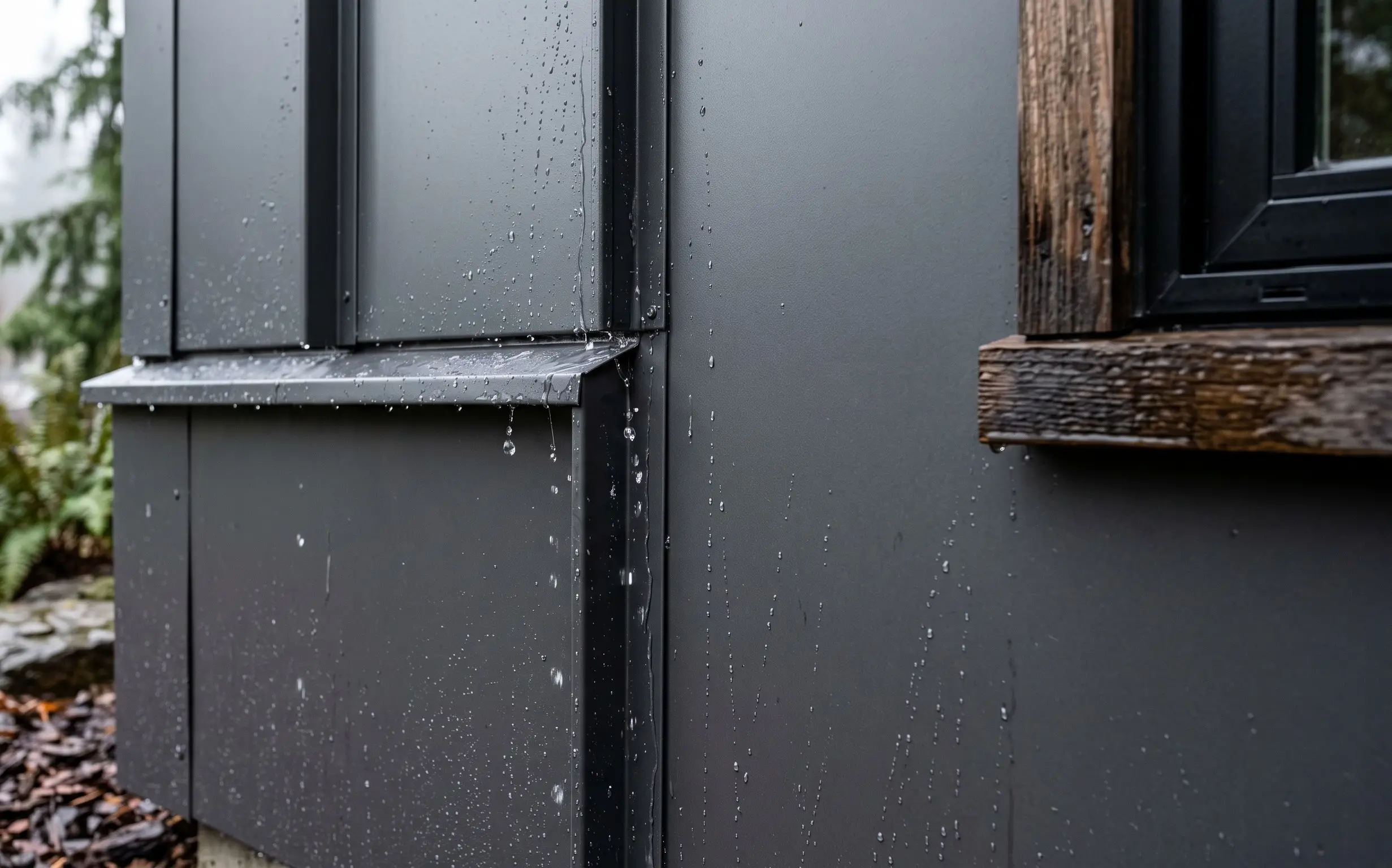
The transitions between metal siding and windows, doors, corners, and soffits require specific trim components and sealant details. In Greater Seattle’s wet climate, these transitions are the most common source of water infiltration on metal-sided buildings — not failures in the field of the panels themselves. We flash and detail all transitions to the standard required for the climate.
Common Metal Siding Issues in Greater Seattle — and How We Address Them
Surface Coating Damage and Corrosion
While metal siding is inherently corrosion-resistant, damage to the factory-applied finish — from impact, scratching, or improper cutting technique — can expose bare metal to the elements. In Greater Seattle’s damp, coastal-influenced climate, unprotected cut edges or scratched field areas can develop surface rust. We cut panels with appropriate tools that don’t create heat that degrades the cut edge, and we treat all cut edges with factory-specified touch-up products.
Oil Canning
Oil canning is a waviness or undulation visible in flat metal panel surfaces that occurs when panels are over-stressed during installation — usually from over-tightening fasteners or insufficient allowance for thermal movement. It’s primarily a cosmetic issue but can indicate installation error. We select panel profiles, installation patterns, and fastener techniques that minimize oil canning on flat field panels.
Panel Joint Separation
Exposed fastener systems and lap joint systems can develop joint gaps over time as thermal cycling causes repeated expansion and contraction. Regular inspection and re-sealing of any joint where sealant has failed prevents water infiltration at these points.
Frequently Asked Questions About Metal Siding in Greater Seattle
Is metal siding a good fit for residential homes in Greater Seattle?
Yes — particularly for contemporary, industrial, and cabin-style homes where the aesthetic of metal panels fits the architectural intent. Metal siding is also practical for any homeowner who prioritizes longevity and low maintenance over the appearance of traditional wood or composite siding.
Does metal siding dent easily?
Aluminum siding dents more readily than steel. Steel siding is significantly more impact-resistant and holds up well to the falling branch and debris impacts common in Greater Seattle’s treed environment. Panel thickness also affects dent resistance — thicker gauge panels are more resistant.
How does metal siding handle Greater Seattle's salt air environment?
Properties near Puget Sound experience mild salt air exposure that can accelerate corrosion on unprotected steel surfaces. Quality Galvalume-coated steel siding with a factory-applied paint system performs well in this environment; aluminum siding is naturally corrosion-resistant and doesn’t require special specification for coastal proximity.
Can metal siding be painted?
Yes. Metal siding can be repainted when the factory-applied finish begins to fade or chalk — typically every 20 to 30 years. Repainting requires proper surface preparation, an appropriate primer for the specific metal substrate, and exterior paint rated for metal surfaces. We can assess and advise on repainting conditions for existing metal-sided homes.
What warranty does Integrity Roofing provide on metal siding installations?
All metal siding installations are covered by our 20-year workmanship warranty. Manufacturer finish and material warranties vary by product; most quality steel siding products carry 30 to 40-year finish warranties. We provide full warranty documentation at project completion.
Interested in metal siding for your Greater Seattle home? Contact Integrity Roofing & Construction for a free estimate.