



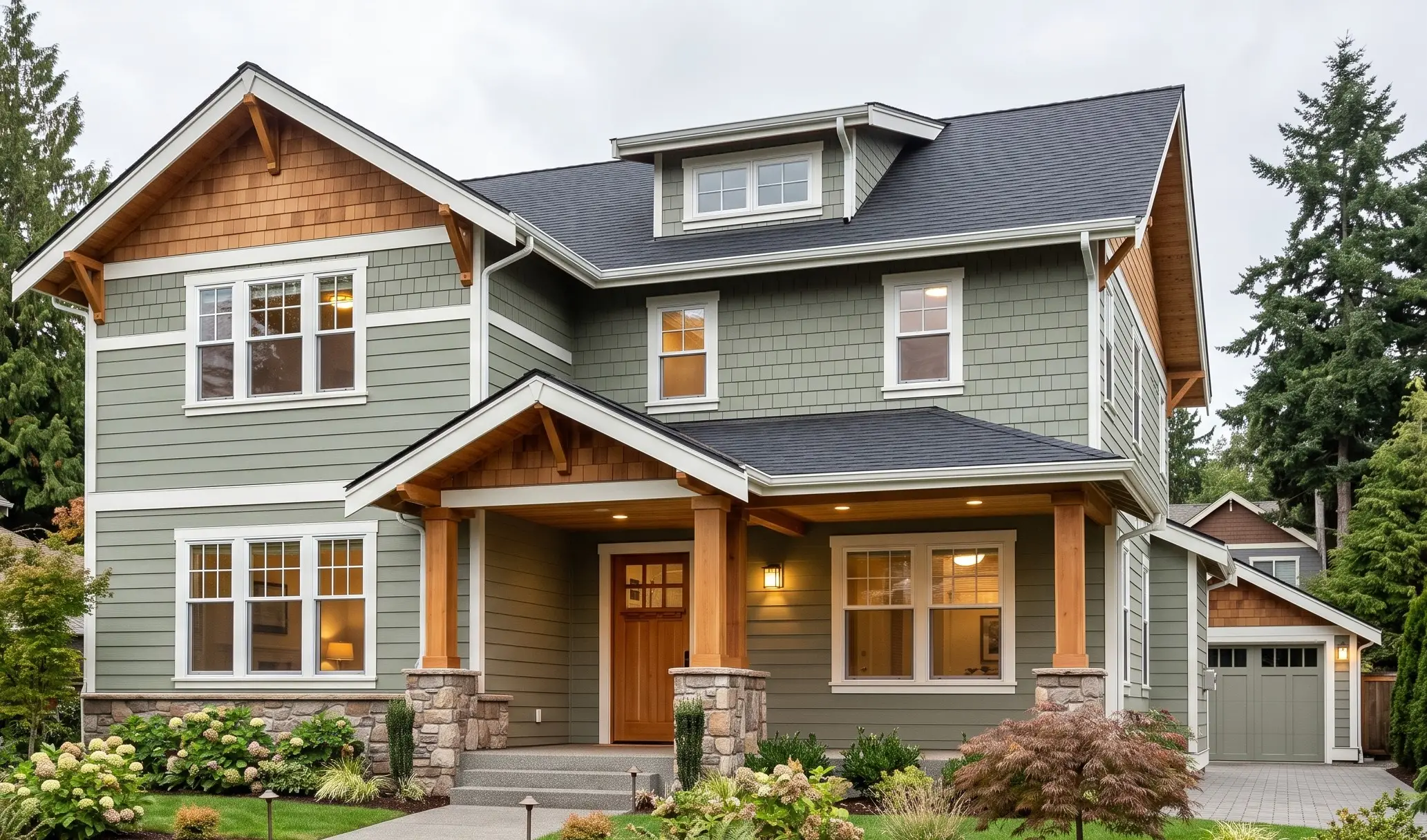
Composite siding has become one of the most popular choices for Greater Seattle homeowners replacing or upgrading their home’s exterior, and for good reason. Engineered composite materials deliver the aesthetic of natural wood siding without the high maintenance demands that wood imposes in a wet Pacific Northwest climate. They resist moisture absorption, dimensional change, rot, and insect activity in ways that natural wood cannot match, while still providing a finished appearance that is difficult to distinguish from the real thing.
Integrity Roofing & Construction installs composite siding throughout Greater Seattle. We work with the leading composite siding products on the market, select materials appropriate for the specific climate conditions of your property, and install every system with the moisture management details that determine long-term performance in the Pacific Northwest.
Schedule your free composite siding estimate with Integrity Roofing & Construction today.
What Is Composite Siding?
Composite siding is a broad category that encompasses any engineered siding product that combines multiple materials — typically wood fiber, resins, polymers, and additives — to produce a product with characteristics superior to natural wood in key performance areas. The most common composite siding types include:
- Fiber cement siding — a blend of Portland cement, sand, and cellulose fiber (see our dedicated fiber cement and Hardie Board pages for full coverage of these products)
- Engineered wood siding — wood fiber and wax or resin binders, producing a product that looks like natural wood with improved moisture resistance (LP SmartSide is the leading brand — see our dedicated LP SmartSide page for full coverage)
- Polymer/PVC composite siding — fully synthetic products with no wood fiber content, offering maximum moisture resistance and zero rot risk
- Wood-plastic composite siding — a blend of wood fiber and plastic resins, positioned between engineered wood and PVC composites in terms of composition and performance
This page covers the composite siding category broadly, with specific attention to polymer and wood-plastic composite systems. Fiber cement (including Hardie Board) and LP SmartSide engineered wood are covered in their own dedicated pages.
Why Composite Siding Performs Well in Greater Seattle
Greater Seattle’s combination of sustained rainfall, moderate temperatures, and high humidity creates specific demands for siding materials. Composite siding addresses the most common failure modes of natural wood siding in this climate:
- Reduced moisture absorption — composite products absorb significantly less water than natural wood, reducing the swelling, shrinking, and eventual rot that affects untreated or poorly maintained wood siding
- Dimensional stability — composite materials maintain their shape through Greater Seattle’s wet-dry seasonal cycles better than natural wood, reducing paint cracking and joint separation
- Rot resistance — composite siding does not rot, regardless of moisture exposure, making it suitable for the consistently damp conditions of the Pacific Northwest
- Insect resistance — composite materials do not provide a food source or harborage for carpenter ants, termites, or other wood-boring insects common in Greater Seattle’s wooded environment
Composite Siding Installation Details That Matter in Greater Seattle
Weather-Resistive Barrier
The weather-resistive barrier (WRB) — house wrap or building paper installed behind the siding — is the critical moisture management layer in any siding system. In Greater Seattle’s wet climate, the WRB must be properly lapped, taped at seams, and integrated with window and door flashings to create a continuous plane of water resistance behind the siding. We install WRBs to the detail level required by the climate, not the minimum required by code.
Proper Clearances and Drainage
Composite siding must be installed with proper clearances from horizontal surfaces — decks, roof planes, and grade — to prevent moisture wicking at the bottom edge of the siding system. Inadequate clearance is one of the most common sources of premature composite siding failure. We assess existing conditions and ensure clearances meet manufacturer requirements before installation begins.
Joint and Seam Management
Butt joints, corner treatments, and window and door trim integration are the most vulnerable points in any siding system. We use appropriate joint treatments — caulking, flashing tape, or trim components specified by the siding manufacturer — at every seam and transition to prevent water infiltration.
Fastening to Manufacturer Specifications
Composite siding products have specific fastener requirements — size, spacing, penetration depth, and fastener material — that differ by product. Incorrect fastening causes siding to buckle, pull away from the substrate, or void the manufacturer’s warranty. We follow manufacturer fastening specifications on every installation.
Common Composite Siding Problems in Greater Seattle — and How We Address Them
Moisture Infiltration at Penetrations
Even composite siding that performs well across its field area can allow water infiltration at utility penetrations, light fixtures, hose bibs, and electrical boxes that weren’t properly sealed at installation. We assess all penetrations and apply appropriate flashing and sealant at every opening in the siding system.
Paint and Finish Adhesion Failure
Most composite siding products require paint or a factory-applied finish system to provide the final barrier against moisture. Paint that peels or fails on composite siding is most commonly caused by surface contamination at installation, inadequate primer, or the use of paint products not rated for the specific composite substrate. We prepare composite surfaces per manufacturer specifications and apply appropriate coatings.
Bottom-Edge Deterioration
The bottom edge of composite siding panels, particularly if installed too close to a horizontal surface or with inadequate clearance from grade, can absorb capillary moisture from wicking, leading to delamination or swelling at the butt. Proper clearances and a correctly installed bottom-edge starter strip prevent this failure mode.
Frequently Asked Questions About Composite Siding in Greater Seattle
How is composite siding different from vinyl siding?
Vinyl siding is an all-plastic product with no wood fiber content. It is the most moisture-proof siding option available but has limitations in paint-ability, impact resistance, and high-end appearance. Composite siding (particularly engineered wood and fiber cement products) typically provides a more authentic wood appearance and greater dimensional rigidity than vinyl, at a higher cost. We’ll help you identify the right product for your priorities during the estimate.
Does composite siding need to be painted?
Most engineered wood composite siding products are sold primed and require field painting after installation. Some products come with factory-applied finishes that extend the painting interval. Fiber cement and certain polymer composites can come pre-finished. We specify paint and finish requirements for the product we install and ensure all field painting meets the manufacturer’s requirements.
How long does composite siding last in Greater Seattle?
Quality composite siding products — properly installed and maintained — typically last 30 to 50 years in Greater Seattle’s climate. Product-specific warranties range from 15 to 50 years depending on the manufacturer and product line. We provide full warranty documentation for every installation.
Is composite siding a good choice for older Greater Seattle homes?
Yes — particularly for homes where natural wood siding has required repeated maintenance cycles and is approaching the end of its useful life. Composite siding installed with proper moisture management details and a quality paint system can perform for decades with significantly less maintenance than the wood it replaces.
What warranty does Integrity Roofing provide on composite siding installations?
Our workmanship on composite siding installations is covered by our standard workmanship warranty. Manufacturer material warranties vary by product; we provide full warranty documentation from the manufacturer at project completion.
Ready to upgrade your siding? Contact Integrity Roofing & Construction for a free composite siding estimate in Greater Seattle.