
Fiber cement siding is the most widely recommended siding category for Pacific Northwest homeowners — and Greater Seattle in particular. The combination of moisture resistance, dimensional stability, resistance to rot and insects, and compatibility with the paint systems that hold up in the region’s wet climate makes fiber cement the category that outperforms alternatives across nearly every relevant metric. It’s not a coincidence that fiber cement has become the dominant siding replacement material in Greater Seattle over the past two decades.
Integrity Roofing & Construction installs fiber cement siding throughout Greater Seattle. As a category, fiber cement encompasses multiple brands and product lines — including the market-leading James Hardie (Hardie Board) products covered in our dedicated Hardie Board page. This page covers the fiber cement category, its composition, performance characteristics, and installation requirements, with guidance on how to choose the right fiber cement product for your home.
Schedule your free fiber cement siding estimate with Integrity Roofing & Construction today.
What Is Fiber Cement Siding?
Fiber cement siding is an engineered composite material made from Portland cement, sand, and cellulose fiber. The cellulose fiber reinforces the cement matrix, giving the finished panel the workability and nail-ability of wood while the cement component provides the moisture resistance, dimensional stability, and fire resistance that cement brings to construction materials. The result is a siding product that:
- Does not absorb moisture like wood
- Does not rot, regardless of moisture exposure
- Is not a food source for carpenter ants, termites, or other insects
- Is non-combustible — carries a Class A fire rating
- Holds paint well — the cement surface provides an excellent substrate for exterior paint systems
- Maintains its shape through Greater Seattle’s wet-dry seasonal cycles with minimal expansion and contraction
Fiber Cement Siding Profiles We Install
Lap Siding (Horizontal)
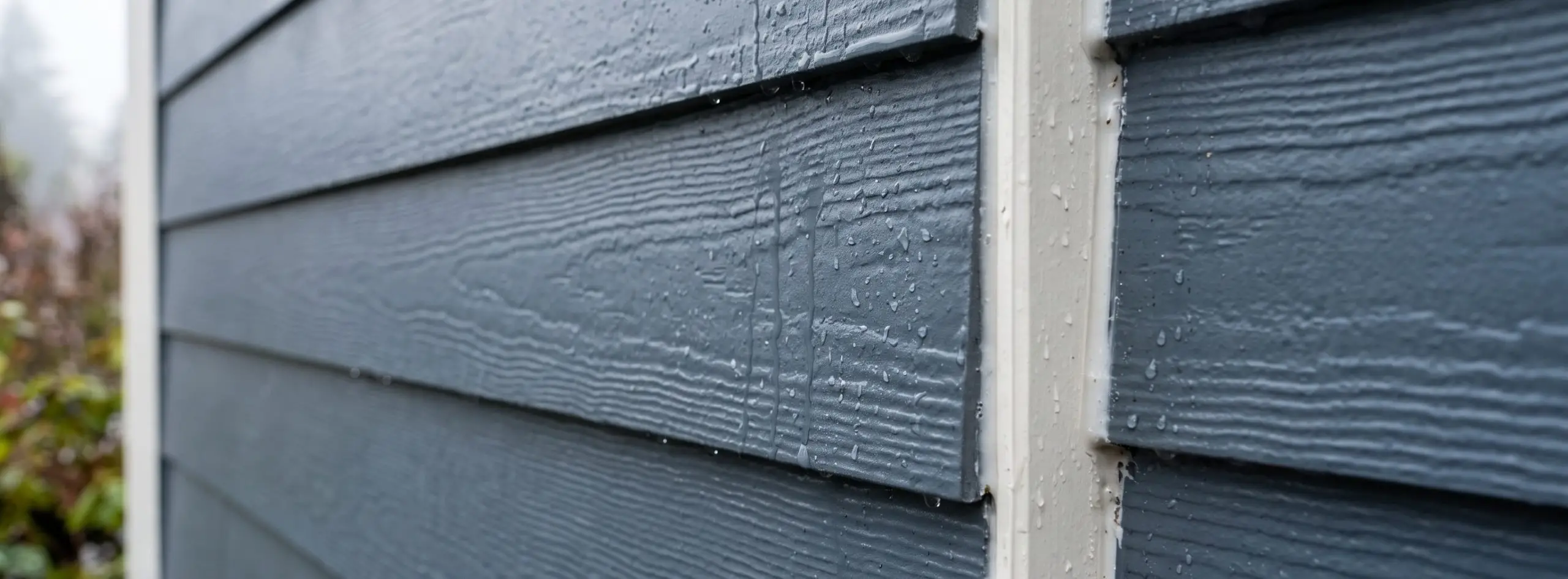
The most common fiber cement profile — a horizontal plank that replicates the appearance of traditional wood lap siding. Available in smooth and wood-grain textures, and in widths from 5.25 to 12 inches, lap fiber cement siding suits a broad range of Greater Seattle home styles from craftsman to contemporary.
Panel Siding (Vertical)
Large-format vertical panels — typically 4×8 or 4×9 feet — are used in board and batten patterns, contemporary siding applications, and as an accent material in combination with horizontal lap siding. Panel siding is more efficient to install over large open wall areas and provides a clean, contemporary aesthetic.
Shingle Siding
Fiber cement shingles replicate the appearance of cedar sidewall shingles — the textured, dimensional wall surface associated with Pacific Northwest cottage and craftsman styles — with the performance characteristics of fiber cement. They’re more durable and lower-maintenance than real cedar shingles in Greater Seattle’s wet climate.
Trim and Fascia Boards
Fiber cement trim boards complement fiber cement siding and provide the same moisture resistance and dimensional stability at window and door surrounds, corners, fascias, and frieze boards — the locations where wood trim most commonly fails in Greater Seattle’s climate.
Why Fiber Cement Is the Recommended Category for Greater Seattle
Fiber cement addresses the specific failure modes that affect Greater Seattle homes most frequently:
Moisture Resistance Without Maintenance Burden
Natural wood siding requires regular painting, caulking, and inspection to perform in Greater Seattle’s wet climate. Fiber cement’s cement composition means it does not absorb moisture, so it doesn’t rot or swell regardless of how much rain it sees. It still requires painting — cement is not inherently waterproof — but a quality paint system on fiber cement lasts 10 to 15 years in most Greater Seattle applications, compared to 5 to 8 years on wood.
Biological Growth Resistance
The cement component of fiber cement does not provide the organic substrate that supports moss, algae, or fungal growth. While some biological growth can establish on painted surfaces over time in Greater Seattle’s damp conditions, fiber cement is significantly less susceptible than wood or some composite products.
Fire Resistance
Greater Seattle’s wooded environment means that fire risk — from adjacent structure fires if not from direct wildfire — is a real consideration. Fiber cement’s Class A fire rating provides a meaningful level of protection that wood siding cannot match.
Fiber Cement Installation Details That Matter in Greater Seattle
Weather-Resistive Barrier
Fiber cement manufacturers specify WRB requirements as part of their installation details. In Greater Seattle’s climate, we install WRBs with the lapping, sealing, and penetration flashing detail that the climate demands — not the minimum required by code.
Fastening
Fiber cement must be nailed into framing — not just into sheathing — with the correct nail size, penetration depth, and spacing. Over-driven nails crack the siding face; under-driven nails leave the panel loose. We follow manufacturer fastening specifications on every installation.
Joint and Penetration Sealing
All butt joints, trim interfaces, and penetrations through fiber cement siding must be sealed with appropriate sealant. Fiber cement manufacturers specify the joint treatment products compatible with their siding systems. We seal all joints per manufacturer instructions.
Painting and Finishing
Factory-primed fiber cement must be painted within the manufacturer’s specified window after installation — typically 180 days. We coordinate the painting timeline as part of every project and apply paint systems appropriate for the Pacific Northwest climate.
Common Fiber Cement Siding Issues in Greater Seattle — and How We Address Them
Paint Failure
Paint on fiber cement fails for several common reasons in Greater Seattle: inadequate surface preparation, use of paint not rated for the substrate, applying paint outside the manufacturer’s temperature and humidity specifications, or failure to prime raw cut ends. We prepare surfaces per manufacturer specifications, use paint products appropriate for fiber cement in Pacific Northwest conditions, and prime all cut ends before installation.
Joint Cracking and Opening
Butt joints in fiber cement siding can open as caulk ages and as the wall system behind the siding moves seasonally. Open joints allow water to reach the WRB and can lead to water infiltration if the WRB is compromised at those points. Regular caulk inspection and touch-up at joints is the most important ongoing maintenance task for fiber cement siding.
Bottom-Edge Moisture Wicking
The bottom edge of fiber cement panels can wick capillary moisture if installed too close to a horizontal surface — a deck, a roof plane, or grade. This causes paint failure and, over time, degradation of the bottom edge. We ensure proper clearances are maintained during installation and install the appropriate starter strip at all bottom edges.
Frequently Asked Questions About Fiber Cement Siding in Greater Seattle
Is fiber cement the same as Hardie Board?
James Hardie products — commonly called Hardie Board — are the market-leading fiber cement brand and are one product line within the broader fiber cement siding category. Other manufacturers produce fiber cement siding products as well. Hardie Board is covered in depth on our dedicated Hardie Board page. This page covers the fiber cement category as a whole, including how to evaluate products across the category.
How long does fiber cement siding last in Greater Seattle?
Quality fiber cement siding — properly installed, primed, and painted — typically lasts 30 to 50 years in Greater Seattle’s climate. Most manufacturers offer 30-year limited warranties on their fiber cement products. The material itself has an indefinite lifespan; the practical limit is typically the paint system’s maintenance cycle.
Does fiber cement siding require painting?
Yes. Fiber cement is sold primed and must be painted within the manufacturer’s specified window. The paint system is the water barrier for the cement substrate; unpainted fiber cement absorbs water and degrades. We coordinate the painting of all fiber cement installations as part of the project scope.
Can fiber cement be installed in any climate zone in Greater Seattle?
Yes. Fiber cement is appropriate for all climate conditions within the Greater Seattle area — including the wetter, higher-rainfall western slopes and the milder conditions of the Eastside and inland areas.
What warranty does Integrity Roofing provide on fiber cement siding installations?
All fiber cement siding installations are covered by our 20-year workmanship warranty. Material warranties vary by manufacturer and product line; we provide full manufacturer warranty documentation at project completion.
Ready to upgrade to fiber cement siding? Contact Integrity Roofing & Construction for a free estimate in Greater Seattle.