
James Hardie products — collectively known as Hardie Board — are the dominant brand in the fiber cement siding category and one of the most specified exterior siding products for Greater Seattle residential projects. HardiePlank, HardiePanel, HardieShingle, and the full James Hardie product family are formulated specifically for the climate zones they’re installed in, and Hardie products specified for the Pacific Northwest include the moisture resistance and dimensional stability characteristics required for Greater Seattle’s sustained wet seasons.
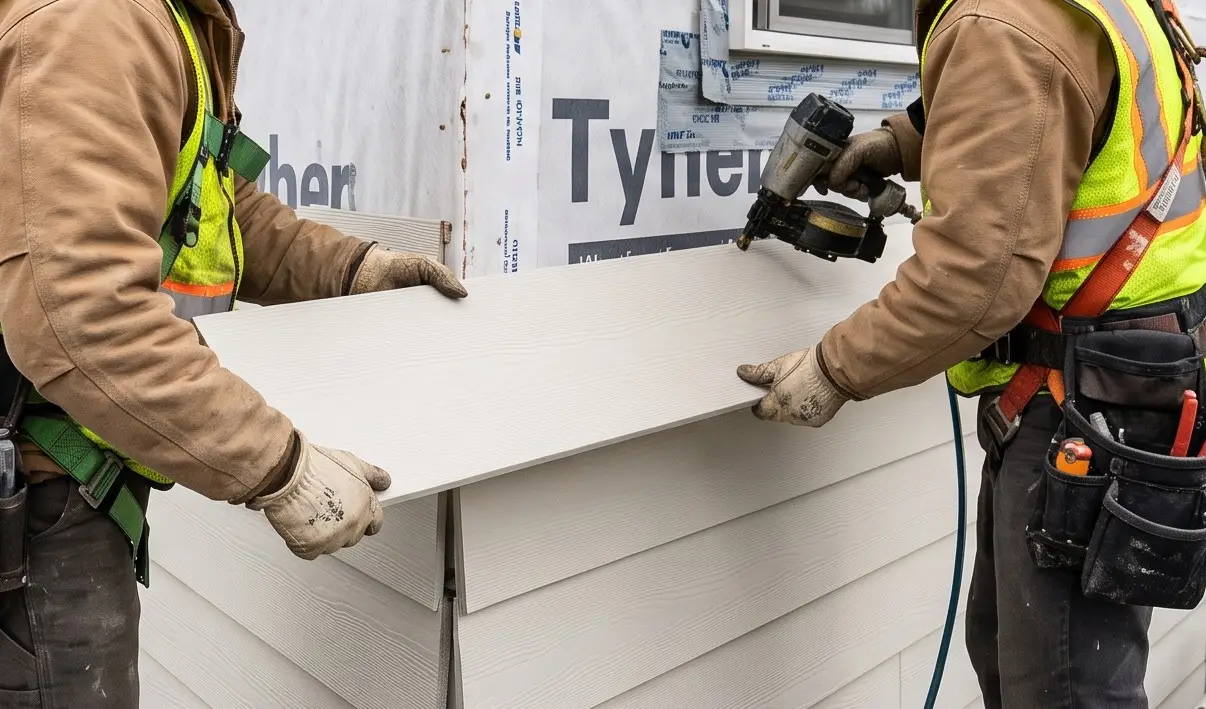
Integrity Roofing & Construction installs the full line of James Hardie siding products throughout Greater Seattle. Hardie installation has specific requirements — fastening, joint sealing, painting, and sequencing with other trades, that differ from general siding installation. We follow Hardie installation specifications precisely, because adherence to those specifications is what keeps the product warranty intact and the installation performing over its full expected lifespan.
Schedule your free Hardie Board siding estimate with Integrity Roofing & Construction today.
The James Hardie Product Line
HardiePlank Lap Siding
HardiePlank is the flagship James Hardie product and the most commonly installed fiber cement lap siding in the United States. Available in smooth and wood-grain (Cedarmill) textures and in widths from 5.25 to 12 inches, HardiePlank is suitable for virtually every residential architectural style in Greater Seattle — from traditional craftsman to contemporary. It’s available primed (for field painting) or in the ColorPlus Technology factory-applied finish, which extends the painting interval and carries a 15-year finish warranty from James Hardie.
HardiePanel Vertical Siding
HardiePanel is a large-format vertical siding panel — typically 4×8 or 4×10 feet — used in board and batten applications, contemporary siding designs, and as an accent material in combination with HardiePlank. HardiePanel provides coverage efficiency over large open wall areas and a clean, contemporary aesthetic that’s well-suited to the modern Pacific Northwest home.
HardieShingle Siding
HardieShingle replicates the appearance of cedar sidewall shingles in fiber cement — offering the dimensional, textured look associated with craftsman and cottage architecture without the maintenance demands of real cedar in Greater Seattle’s wet climate. HardieShingle is available in individual shingle strips and staggered-edge panels.
HardieTrim Boards
HardieTrim fiber cement trim boards are used at corners, windows, doors, fascias, and frieze boards — providing the same moisture resistance and dimensional stability as the field siding at all the locations where trim is most vulnerable to moisture infiltration and decay in Greater Seattle’s climate.
HardieWrap Weather Barrier
James Hardie’s proprietary weather-resistive barrier is designed specifically for use with their siding systems. HardieWrap provides the drainage plane, air barrier, and moisture management layer behind the siding that is critical in Greater Seattle’s wet climate.
Hardie Board vs Other Fiber Cement Products — What Sets It Apart
James Hardie is not the only fiber cement siding manufacturer, but it has several product-specific attributes that distinguish it within the category:
- HZ10 climate-specific formulation — Hardie products for the Pacific Northwest (Zone 10) are formulated with moisture content and density specifications appropriate for high-humidity, sustained-rainfall climates
- ColorPlus Technology — James Hardie’s factory-applied multi-coat baked finish system provides a more uniform, durable finish than field-applied paint and carries a 15-year warranty against peeling, cracking, and fading
- 30-year non-prorated product warranty — the James Hardie limited product warranty covers defects in the siding material itself for 30 years on most products
- Industry-leading market share and testing history — Hardie products have been installed in Pacific Northwest climates for decades, providing a well-documented performance track record
Hardie Board Installation Requirements in Greater Seattle
Fastening Specifications
Hardie siding has specific nail type, size, and spacing requirements. The nails must penetrate into framing members — not just sheathing — to the specified depth. Over-driven nails crack the face of the siding and void the warranty; under-driven nails leave the siding loose. James Hardie provides specific fastening guides for each product and installation configuration. We follow these guides on every installation.
Joint and Seam Treatment
James Hardie specifies the caulk products and joint treatment details for each of their siding products. Hardie requires specific caulk products at butt joints — products not on the approved list can fail prematurely or damage the siding surface. We use James Hardie-approved joint treatment materials on every installation.
Clearances from Horizontal Surfaces
Hardie specifies minimum clearances from rooflines, decks, and grade — 1 inch from horizontal surfaces and 6 inches from grade. These clearances prevent moisture wicking from horizontal surfaces into the bottom edge of the siding and are a warranty requirement. We ensure all clearances are maintained during installation.
Painting Within the Specified Window
Factory-primed Hardie products must be painted within 180 days of installation. We coordinate the painting timeline as part of every Hardie siding project and apply exterior paint products compatible with fiber cement substrates.
Common Hardie Board Issues in Greater Seattle — and How We Address Them
Paint Adhesion Failure at Cut Ends
Cut ends of Hardie siding panels expose raw fiber cement that must be primed before installation. Unprimed cut ends absorb moisture and are a common point of paint failure. We prime all cut ends with James Hardie-approved primer before installation — a detail that some installers skip but that is required by the Hardie installation guide and the product warranty.
Joint Separation and Caulk Failure
Butt joints in Hardie siding caulked with incompatible products crack and open prematurely, allowing water infiltration behind the siding and to the WRB. We use James Hardie-approved caulks at all joints and inspect joint conditions during any service visit.
Improper Clearances
Hardie siding installed too close to a deck, roof plane, or grade wicks capillary moisture at the bottom edge, causing paint failure and deterioration of the bottom edge of the panel. We identify and correct improper clearances during Hardie siding repair and replacement work.
Fastener Cracking
Hardie panels cracked at fastener locations are a sign that nails were over-driven — typically with an improperly set pneumatic nailer. Cracked panels must be replaced. We use correctly set fastening equipment and verify fastener head depth on every panel during installation.
Frequently Asked Questions About Hardie Board Siding in Greater Seattle
What is the difference between Hardie Board and generic fiber cement siding?
Hardie Board refers specifically to James Hardie products — the market leader in fiber cement siding with products formulated for specific climate zones. Generic fiber cement siding products use the same basic material composition (Portland cement, sand, cellulose fiber) but differ in formulation, density, texture options, and warranty coverage. Hardie’s HZ10 Pacific Northwest formulation and ColorPlus finish system are specific advantages for Greater Seattle installations.
Is Hardie Board worth the cost premium over other siding materials?
For most Greater Seattle homeowners replacing old wood or vinyl siding, yes. The combination of Hardie’s 30-year product warranty, the ColorPlus finish system’s 15-year finish warranty, and the product’s documented performance in Pacific Northwest climates provides a total cost of ownership advantage over lower-cost alternatives that require more frequent maintenance and earlier replacement.
Does Hardie Board need to be painted?
Factory-primed Hardie products require field painting within 180 days. Hardie ColorPlus products come factory-finished and do not require field painting — the factory-applied finish is warrantied for 15 years. ColorPlus adds cost at installation but reduces the first painting interval and provides a more uniform finish than field-applied paint.
How long does Hardie Board siding last in Greater Seattle?
James Hardie provides a 30-year non-prorated product warranty on most HardiePlank and HardiePanel products. In practice, properly installed and maintained Hardie siding in Greater Seattle routinely performs for 30 to 50 years without the need for material replacement — the paint system is the primary maintenance item over that period.
What warranty does Integrity Roofing provide on Hardie Board installations?
All Hardie Board installations are covered by our 20-year workmanship warranty, in addition to the James Hardie 30-year product warranty and the 15-year ColorPlus finish warranty (for ColorPlus products). We provide full warranty documentation from James Hardie at project completion.
Ready for Hardie Board siding installed right? Contact Integrity Roofing & Construction for a free estimate in Greater Seattle.