




Attic ventilation systems rely on consistent airflow to manage heat and moisture. Traditionally, this airflow is achieved by combining low-mounted intake vents with high-mounted exhaust vents. However, real-world roof designs do not always allow for ideal vent placement. In these situations, box vents can sometimes serve a dual role when used correctly.
Understanding when a box vent can function as either intake or exhaust, and when it should not, is essential for protecting roof performance, energy efficiency, and long-term durability.
The Basics of Intake and Exhaust Ventilation
A properly ventilated attic depends on two distinct airflow functions. Intake vents allow fresh outside air to enter the attic, while exhaust vents allow warm, moisture-laden air to exit. This continuous exchange helps regulate attic temperature and moisture levels.
Proper attic ventilation balances airflow between intake and exhaust vents. According to the ENERGY STAR guide to attic ventilation, natural airflow helps protect roof components by moving heat and moisture out of attic spaces.
When intake and exhaust are balanced, air moves through the attic space in a controlled path. When that balance is disrupted, airflow becomes inefficient and problems can develop. These problems often include heat buildup, condensation, mold growth, and premature aging of roofing materials.
What Box Vents Are Designed to Do
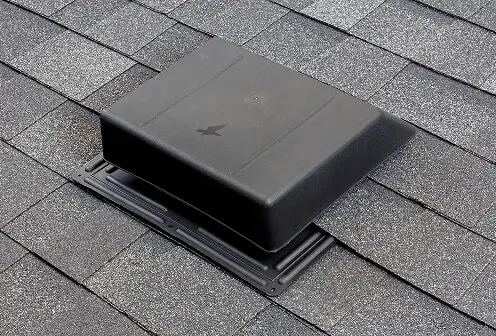
Box vents, also known as static vents, are most commonly installed as exhaust vents near the upper portion of the roof. They do not rely on mechanical components or wind-driven turbines. Instead, they allow warm air to escape naturally through convection.
Because box vents are passive, their performance depends heavily on proper placement and adequate intake airflow. When intake vents are missing or blocked, box vents may struggle to exhaust air effectively. Industry guidance from the HVI attic ventilation principles highlights that vents must allow both incoming and outgoing airflow across the attic to reduce heat and humidity buildup.
Can a Box Vent Be Used as an Intake Vent
In certain applications, a box vent can be installed lower on the roof and function as an intake vent. This approach is not appropriate for every roof, but it can be useful when traditional intake options are limited or unavailable.
When used as intake, a box vent allows fresh air to enter the attic at a lower point, supporting airflow toward higher exhaust vents. This can help restore balance in attic ventilation systems that otherwise lack sufficient intake.
It is important to note that not all box vents are approved or tested for use as intake vents. Product design, testing standards, and installation location all matter.
Factors That Determine Whether a Box Vent Can Serve as Intake
Several conditions must be met before a box vent can be used as an intake vent.
First, the vent must be specifically designed and tested for low-roof installation. Vents installed near the eave line are more exposed to wind-driven rain and debris, which makes weather protection critical.
Second, placement matters. Intake vents should be installed low on the roof plane to promote proper airflow direction. Installing a box vent too high can cause it to act as an exhaust instead of an intake.
Third, the overall ventilation system must be evaluated. A box vent used as intake should complement existing exhaust vents rather than compete with them. Improper placement can lead to short-circuiting, where air exits before it has a chance to ventilate the attic space.
The Importance of Product Testing and Ratings
When considering a box vent for intake use, it is essential to confirm that the product has been tested for that application. Testing standards help ensure that vents can resist weather intrusion and perform safely in exposed locations.
Using a vent outside of its intended or tested application can increase the risk of leaks, moisture entry, and long-term roof damage. Always refer to the manufacturer’s documentation and installation instructions before selecting a vent for intake use.
Common Situations Where Dual-Purpose Use May Be Considered
There are several scenarios where using a box vent as intake may be appropriate.
Homes with limited or blocked soffit areas may lack sufficient intake ventilation. In these cases, low-mounted roof intake vents may be the only viable option.
Complex roof designs with limited eave access can also benefit from alternative intake solutions. Renovations and additions may further restrict traditional intake pathways.
In each of these situations, the goal remains the same. Establish balanced airflow without compromising weather protection or roof integrity.
Risks of Improper Box Vent Placement
Using box vents incorrectly can create more problems than it solves. Installing box vents too close together or mixing intake and exhaust vents at similar heights can disrupt airflow patterns.
This disruption may cause hot air to exit prematurely or allow moisture to linger inside the attic. In some cases, it can even draw conditioned air from the living space into the attic, reducing energy efficiency.
As noted in the ARMA technical bulletin on attic ventilation importance, correct vent placement and balanced airflow play a key role in prolonging roof life and minimizing moisture problems.
Evaluating the Entire Ventilation System
No single vent should be evaluated in isolation. Attic ventilation performance depends on how all components work together.
A thorough evaluation should include intake capacity, exhaust capacity, vent placement, roof pitch, attic size, insulation layout, and local climate conditions. Making changes to one part of the system without considering the rest can lead to unintended consequences.
Why Professional Assessment Matters
Determining whether a box vent can safely and effectively serve as intake requires experience and system-level understanding. Professional assessments help identify ventilation deficiencies, confirm appropriate vent selection, and ensure proper installation.
This approach reduces the risk of moisture problems, protects roofing materials, and supports long-term performance.
Making Informed Ventilation Decisions
Box vents can be a valuable tool when used correctly, including in limited intake applications where product design and testing allow. The key is understanding airflow principles and applying them thoughtfully to each roof.
Attic ventilation is not a one-size-fits-all system. Careful planning and proper installation make the difference between a roof that simply has vents and a roof that performs as intended.
When to Seek Expert Guidance
If a home has persistent attic moisture issues, uneven temperatures, or limited intake ventilation options, professional guidance can help determine the most effective solution.
For expert evaluation of attic ventilation and roof performance, call Integrity Roofing & Construction at 360-900-7663 or fill out our online form to schedule your video inspection today.